
Moreover, a 2019 NSCA position statement says a properly designed resistance training program is safe for healthy older adults, providing a reassuring foundation.
Maybe you stand in the gym after work and think you missed your chance years ago. That's a common misconception. Decades are not deadlines. The key is starting with a manageable plan rather than pushing too hard immediately.
Can you really build muscle and strength after 40, 50, or 60?
Yes. Older adults can still gain muscle mass and strength with resistance training.
A 2022 meta-analysis showed a 1.0 kg increase in total muscle mass following resistance training 2-3 times per week. Strength improvements appear across various training styles; a 2025 network meta-analysis found moderate to large strength gains with machine-based training (SMD=1.34), free weights (SMD=1.15), elastic bands (SMD=0.93), mixed training (SMD=0.88), and bodyweight exercises (SMD=0.71). This means you don't need perfect equipment to start.
Is lifting weights safe if starting later in life?
Yes, for healthy older adults, well-designed resistance training is safe.
The 2019 NSCA statement emphasizes safety requires proper technique, supervision, and smart exercise selection. Safety depends more on these factors than on age. Reckless lifting is risky at any age, but sensible, progressive training is well supported by research.
How often should a beginner over 40, 50, or 60 lift?
Starting with about 2 sessions per week is recommended.
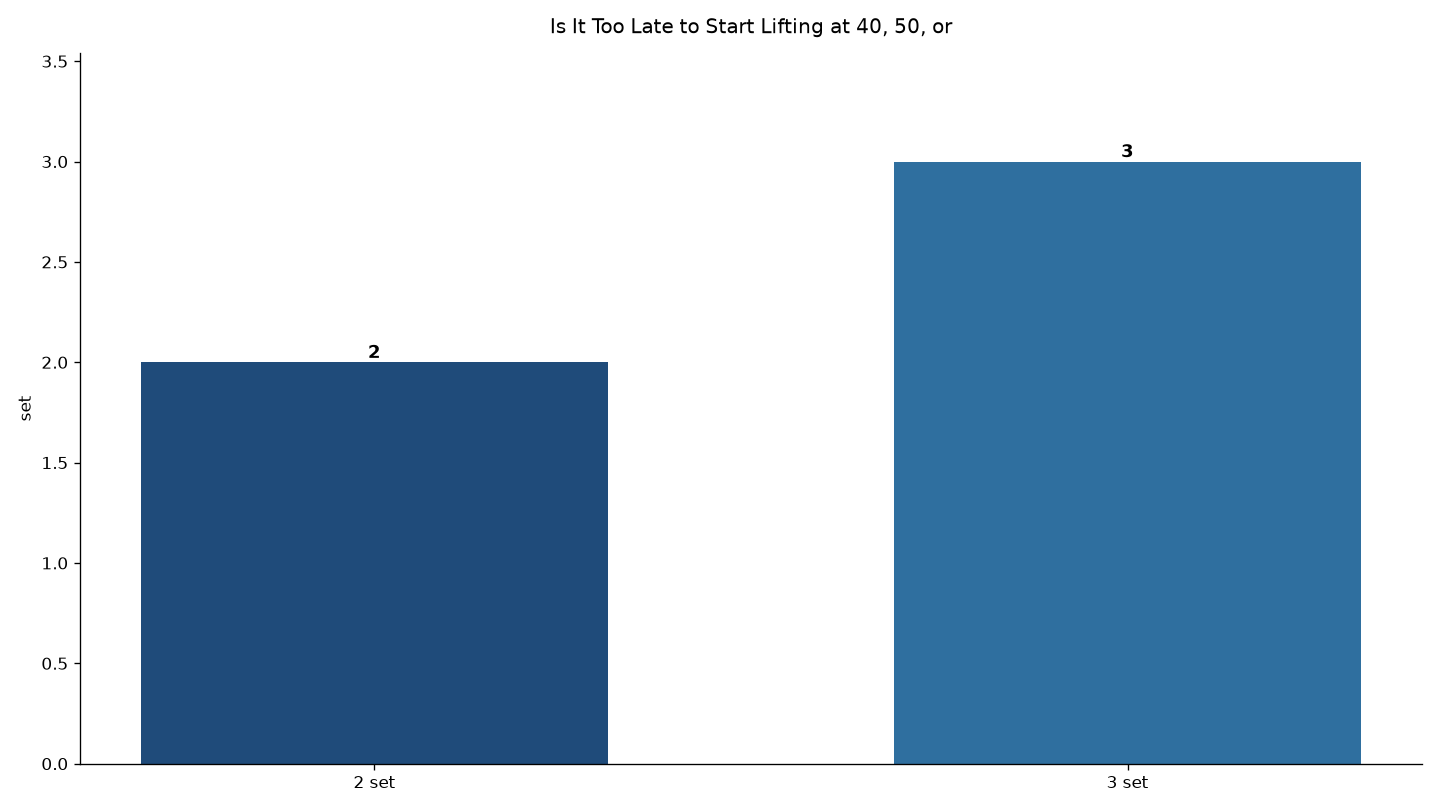
The NIH advises aiming for at least 2 days of resistance training weekly; the 2019 NSCA statement recommends working toward 2-3 times per week, including 2-3 sets of 1-2 multijoint exercises per major muscle group.
A simple, repeatable routine helps build consistency and recovery:
| Good starting option | Why it works |
|---|---|
| Two full-body sessions per week | Easier to recover and maintain consistency |
| Few exercises | Allows focus on technique |
| Rest days between sessions | Permits joint and muscle adaptation |
Do you need heavy weights right away to make progress?
No, you can start lighter and build gradually.
The NSCA recommends working toward 70-85% of one repetition maximum (1RM) for some resistance work, and 40-60% 1RM for power exercises, but beginners don't need to start there immediately. Learning movements with submaximal loads and leaving repetitions in reserve is a smart way to progress.
What is the biggest mistake older beginners make?
Trying to make up for lost time by training too hard immediately.
This often leads to poor technique, excessive soreness, and skipped workouts. Instead, focus on consistency and gradual progress:
- Choose a few basic movements
- Stop sets before technique breaks down
- Repeat the same plan long enough to learn it
- Add load or reps only when ready
Strength and muscle grow better with steady progress than with panic.
When should you check with a doctor before starting?
If you have any health concerns or risks, consult a healthcare professional before beginning or progressing training.
With no contraindications, starting modestly and safely is usually best.
What to do in your next session?
Perform a short full-body session, ending with the feeling you could have done a bit more:
- Select 1-2 multijoint exercises per major area
- Use controllable loads with good technique
- Complete a few work sets
- Rest adequately between sets
- Record your session details to guide next time
Aim to work toward 2-3 sets of 1-2 exercises per muscle group, 2-3 times per week, as a longer-term target.
If you want a simple way to follow a plan, log workouts, and track your history and measurements, Roarer is designed for that.