

Changing your strength program every two weeks will stall your progress, not spark it. Evidence shows this habit disrupts both skill development and progressive overload, leaving you less strong and more frustrated. Patience pays off: small changes can keep things fresh, but skills and strength need consistency to grow.

Switching out all your key lifts every two weeks means you never get the full benefit of learning movement patterns or reliably challenging your muscles. As a 2012 PM&R periodization review summarizes, "When you switch exercises every week or two, you never spend enough time… to develop technical proficiency," as training coaches often summarize. Microcycle mastery and progress measured, not disrupted, should be your goal.
Why is progressive overload hard to track when changing programs every two weeks?
Progressive overload only works if you can actually compare results over time. When you change your program wholesale every two weeks, you lose your baseline. You cannot tell if you are getting stronger, simply because the movements and rep schemes keep shifting.
- Tracking the same lifts lets you see real progress.
- Frequent changes break your ability to measure improvement.
- Without consistent metrics, motivation can drop and results stall.
A 2012 PM&R periodization review makes it clear you "have no consistent baseline to measure against" if you constantly swap exercises.
If you're always switching your training program, it's almost like starting from scratch every time. Consider a lifter working on squats for just two weeks: just as their form starts to dial in and weights go up, they're switching to lunges, and any hard-won technical progress is lost. There's no opportunity to see if the weight on the bar is increasing from month to month. Even subtle tweaks in grip, angle, or machine can alter the movement enough to erase any sense of continuity-making it difficult or impossible to judge if you're really making gains.
How long does it take to develop technical proficiency and neural adaptation on a lift?
It takes at least 2-4 weeks for your nervous system to pick up strength, coordination, and skill in a given lift. These early gains are almost entirely neural-proper firing of muscle fibers, better form, and smoother patterns. Muscle growth only follows after the first 8-12 weeks.
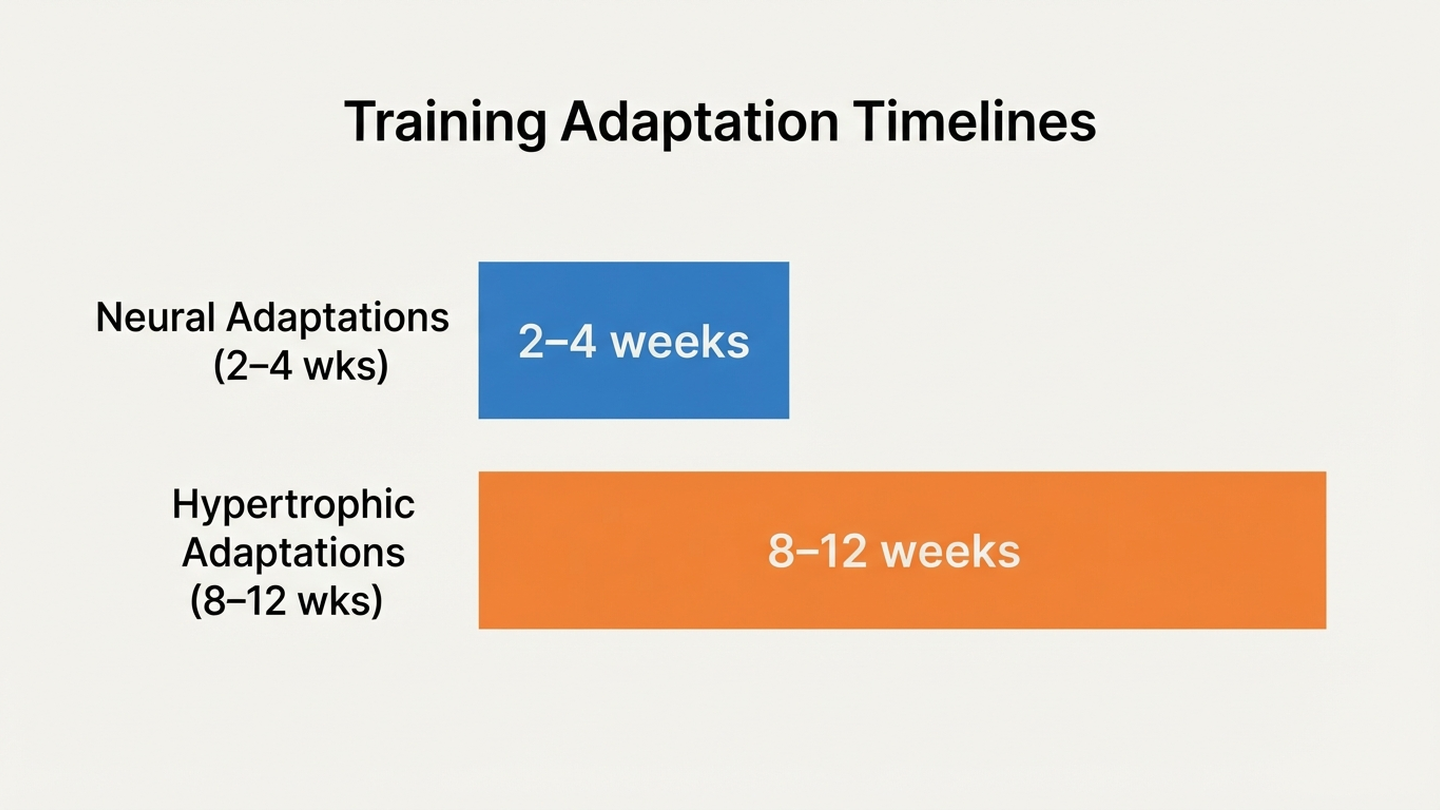
If you keep switching, you bail out just as your body is laying the technical foundation. As a 2012 PM&R review notes, early strength gain is neural "within 2 to 4 weeks … the deeper adaptations… typically become evident after 8 to 12 weeks."
For example, a new lifter following a bench press routine will often find, in the first three weeks, that weights go up quickly-not because their muscles have grown significantly, but because their nervous system is learning the motor pattern: controlling the path, stabilizing the bar, and firing muscles in the right sequence. Only later-after repeated practice and incremental increases in load-does visible muscle growth begin. If the lifter switches from bench to dumbbell press or another chest movement too early, their nervous system never has a chance to "hard-wire" the motion, and the cycle restarts.
What do periodization models recommend as appropriate block lengths?
Classic periodization models suggest that main program blocks, or microcycles, should last longer than two weeks. Three to six weeks is typical for beginners, with block lengths extending as an athlete advances. This approach allows enough time for motor learning, load progression, and performance feedback.
A 2012 review in the PM&R Journal points out that microcycles shorter than two weeks are the exception-not the rule-outside of specialized peak phases. Most athletes and lifters build best on consistency.
Strength coaches and sports scientists regularly construct training cycles that allow at least several weeks of the same movements before major program changes. This provides an objective period to track increases in weight, improvements in technique, and adaptations in the body. By sticking to program blocks of at least three or four weeks, athletes avoid the pitfalls of frequent variation-interrupting their own momentum before results appear.
Can very frequent program changes increase injury risk?
Yes. Constantly swapping movement patterns before mastering them can invite technique breakdown, joint stress, and compensation issues. Without repetition, you lack the chance to "stick-to-skill" and groove safe mechanics before adding load or speed.
ACSM guidance favors periodized, progressive training over random or excessively varied programs.
If you rush variety, you may never learn to stabilize your core on a deadlift or squat, and compensation patterns-where weaker muscles cheat the movement-can go unnoticed and uncorrected, sometimes leading to overuse injuries.
When is program variation helpful vs harmful?
Variation can stop plateaus and keep training fun, but wholesale changes every two weeks cross the line from helpful to harmful. Small tweaks-like set and rep changes or new accessory movements-work well. Leave novelty for accessories, not the core lifts. Build on consistency and let variation serve, not replace, your program’s structure.
Instead of rewriting every movement, consider rotating your accessory lifts or adjusting volume and intensity on the main lifts while leaving their identity stable. Genuine plateaus are rare within a few weeks of the same core work. Only after progress has clearly stalled should you contemplate modifying a foundational exercise or rebuilding the entire plan.
Even the best-built routine must adapt now and then, but solidify before you switch. Use the Roarer app to track your blocks and spot true progress before making a change that matters.