

Sticking with the same exercise and gradually increasing the load is often the best route to progress, as long as your form stays solid and you can consistently complete more reps than your target. When you hit two extra reps for two workouts in a row, science says it is time to boost the weight rather than search for novelty.
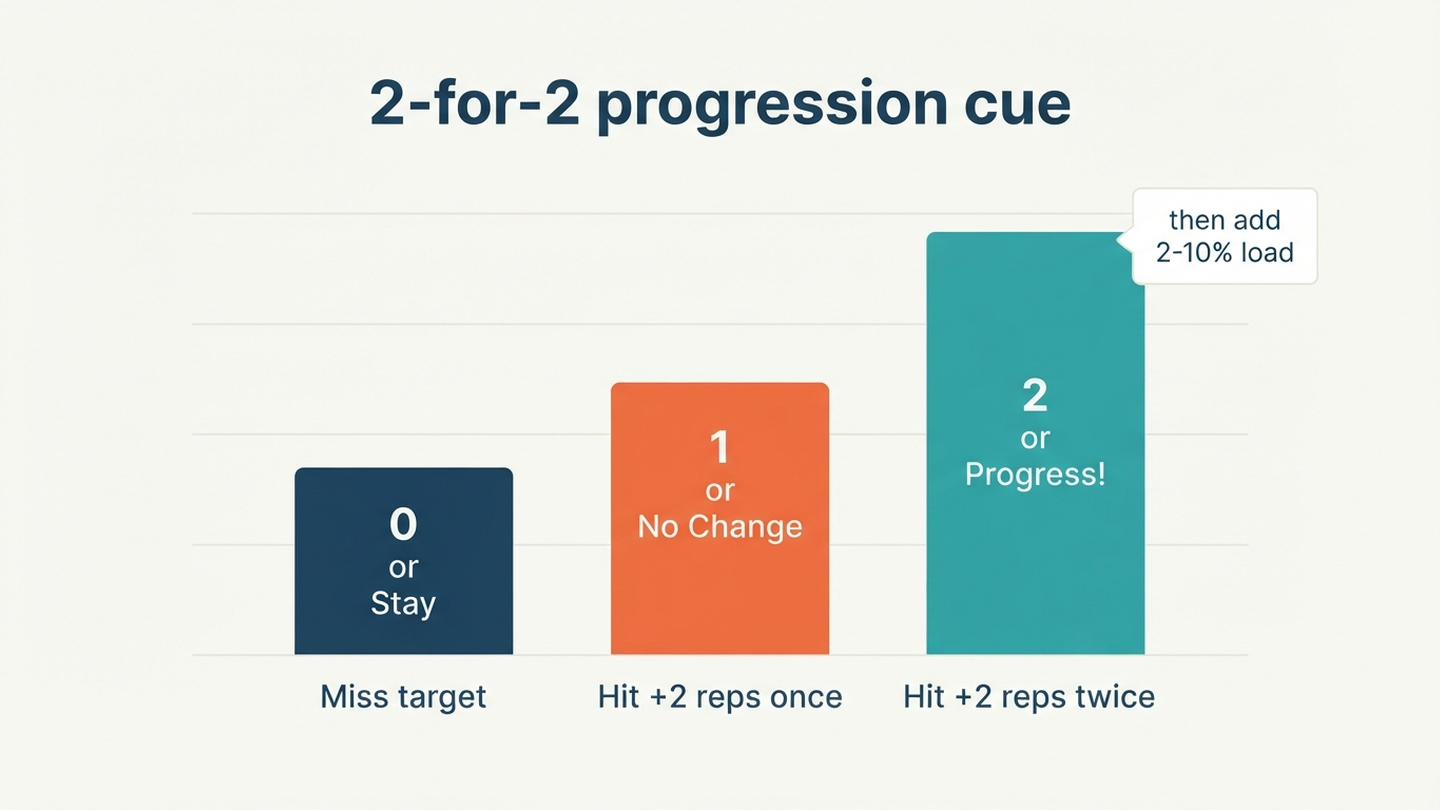
Coaches call this the “2-for-2 rule,” and progressive-overload guidance (including the 2023 American Heart Association statement) points the same way: when you manage two more reps than planned in two consecutive sessions, increase the weight by 2-10%. This measurable approach lets you progress with intention, not impulse. Solid form trumps novelty-progress is a process, not a distraction swap.
What is the “2-for-2” rule in resistance training?
The "2-for-2" rule means that if you complete two extra reps beyond your goal for two back-to-back sessions, it is time to raise the load. This threshold, recommended by both the American Heart Association and NSCA, keeps progression evidence-based and helps avoid stalling. For example, if your program calls for a certain number of reps and you can do two more with strong form across two workouts, use the rule.
How much should I increase the weight when progressing?
Research-backed guidelines recommend upping the load by 2-10%. The lower end (about 2%) suits small muscle groups, while the higher end (up to 10%) fits larger lifts like squats or leg presses. For arms, Harvard specialists suggest adding just 0.5-1 kg, while legs can safely take 1-2 kg jumps. Small increments, big consistency-measure before you modify.
How do guidelines like ACSM and NSCA advise improving strength versus maintaining variety?
Leading organizations prioritize increasing the load with the same movement over frequent swapping. ACSM recommends lifting around 80% of your one-rep max in 2-3 sets per exercise for strength gains. The NSCA adds that maximizing strength calls for at least 85% of 1RM at low reps, while hypertrophy works at 67-85% of 1RM. Keeping the exercise stable allows your body to adapt effectively and gain strength over time.
What are the indications that form and adaptation, not exercise variety, should guide progression?
If your form remains strong and you exceed your rep goals for more than one session, you are adapting and ready for higher loads. Discomfort or boredom are weaker signals compared to objective progress. Log the reps, earn the weight-let numbers drive your choices instead of emotion. Training logs help reveal when it is time to stay the course.
Could increasing volume or frequency be a better progression instead of changing the exercise?
Yes, sometimes increasing the number of sets or weekly sessions can break plateaus, especially in advanced lifters. However, if you are consistently surpassing rep targets, increasing load should be your primary lever. Harvard Health notes that if resistance feels easy (and your form flawless), weight increases work best, but upping volume can supplement progression too.
When is it appropriate to change the exercise rather than continue increasing load?
Swapping exercises is smart when you hit a true plateau even after boosting the weight, if you risk injury, or if you have very limited equipment. Also consider rotating movements for long-term joint health or when specific weaknesses emerge. Scientific stress, not random swap-change with a clear rationale, not out of boredom.

With the Roarer app, tracking rep progress and knowing exactly when to apply the 2-for-2 rule is automatic-making each increase earned by your numbers, not mood swings.